The Science Blue Lava
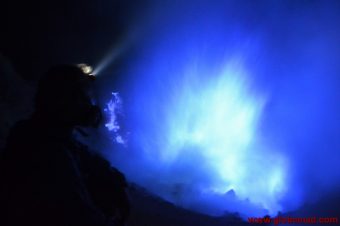
Coming face to face with the blue flames of Kawah Ijen was truly one of my most brilliant and breathtaking travel experiences. Not only is it a beautiful place but it is also one of the most inhospitable and dangerous environments on the planet. The science of blue lava
The science of blue lava

Deep in the bowels of Kawah Ijen, gases are heated by the geothermal energy of magma. The gases are a mixture of substances including the element sulphur (which vaporizes at 444 degrees celsius). As they are heated the gases expand causing the pressure to increase, since space is limited for these expanding gases, they are pushed towards the surface of the earth. Surging through cracks in the ground at a temperature of around 600 degrees celsius the heated gases have enough energy to burst into flames when they mix with the air.
The dancing flames are a blue colour due to electrons in sulphur atoms being excited to higher energy levels during the energetic combustion reaction. When an electron relaxes to the ground state a photon of blue light released. The energy of the blue light corresponds to the energy gap between the excited states and ground state of sulphur. But not all of the sulphur combusts. Some of the escaping sulphur is deposited on the surrounding rocks giving them a brilliant yellow colour which can be seen by day. If you spend some time by the blue flames you may even notice yellow sulphur deposits on your hair, eyebrows and eyelashes! The science of blue lava


Close to the flames some of the unburned sulphur condenses into a liquid, still at high temperatures it burns slowly, flowing down the rocks as it burns with beautiful blue flames. Some sources describe this burning liquid sulphur as “blue lava”. It has been argued that this is technically incorrect because the hot blue liquid it is a molten mineral not a molten rock. When you get close to this burning liquid it is easy to see why people call it blue lava. As it burns it creeps down the mountain flowing around rocks.

The blue flames form plumes of eye watering white clouds which swirl around the caldera. These clouds contain solid particulates, water droplets and oxides of sulphur such as sulphur dioxide SO2 and sulphur trioxide SO3. These oxides are referred to as acidic gases because they readily dissolve in water forming sulphurous acid H2SO3 and sulphuric acid H2SO4 respectively. As soon as these gases come into contact with moisture on the surface of your eyes, mouth, throat and lungs an acidic solution is formed; your eyes stream, your throat burns and you cough involuntarily. Close to the blue flames the gas clouds can be so concentrated it is impossible to see your hand right in front of your face. A gas mask is essential. In a lab these reactions would only be done on a small scale and in a fume cupboard! Here noxious gases spew into the atmosphere in copious volumes.

Next to the blue flames is a giant, ominous green crater lake. With a volume of around 30 million cubic metres this is the largest hyper-acidic lake in the world. Void of life, it has a pH of around zero, an acidity equivalent to car battery acid. Even a short dip in this lake would cause severe acid burns to your skin and a longer stay would entirely dissolve your body with the exception of any gold fillings. The science of blue lava
The lakes owes its acidity to gases such as sulphur dioxide, hydrogen chloride and hydrogen fluoride. These gases bubble into the lake through fumaroles on the lake bed. As the gases dissolve in the lake water they form various acids such as sulphurous acid, hydrochloric acid and hydrofluoric acid. If this isn’t enough to put you off a swim, the water is also heated by the geothermal lake bed and can reach temperatures of 43 degrees celsius a mere 5m below the surface. Many other processes affect the chemistry of the lake: evaporation, rainfall, runoff, and chemical reaction with rocks on the lake bed.

The sophisticated and versatile chemistry of sulphur plays huge role in shaping this hostile environment.
Sulphur has 9 stable oxidation states compared to many main group elements that have 2 or 3 stable oxidation states. Each sulphur atom can expand its valence shell to hold up to 12 electrons rather than the normal maximum of 8 electrons. Consequently sulphur atoms can form a large number of stable compounds when they bond with other atoms like oxygen. Sulphur atoms can also bond with each other in many different ways leading to an array of allotropes (forms) of pure sulphur. Locals collect large chunks of solid sulphur and carry it in ridiculously heavy baskets (80kg or more) to be sold in local villages. Sulphur is used as a reagent to synthesize a wide range of products such as medicines, pigments, pesticides and sulphuric acid.
Kawah Ijen is truly a reminder that some of the most beautiful places on earth can also be the most dangerous. The science of blue lava
Emma has written a gripping account when it started to take a bad turn. It still puts the hairs up on the back of my neck!
Trekking deep into a volcano to explore the blue Lava of Java >>>
How to get to the Kawa Ijen >>>
There’s a pretty cool FREE Kindle Unlimited book on the Science of getting to Middle-earth from Lord of the Rings at the moment and that has some stuff on the science of Volcanoes. You may know a lot of the science already, but it is a pretty cool and clever journey of science.






4 Responses
Annemieke
Love the science stuff!!! Thanks. Well written. What an adventure!!!
Globemad Emma
I thought you might like this one. Pete is soooo good on the science stuff! Fascinates me when he explains it all!
handyman london
very beautiful pictures and very beautiful site
Pete Tryon
Thank you! 🙂 It really is a stunning place isn’t it? So happy you like the website- if we can help you with any planning please let us know.