Table of Contents
Can you do the Patagonia W trek without a guide?
The short answer is yes, the long answer is it is all about being well prepared. It is very possible, but the planning should not be taken too lightly. In this post we will cover a full break down of the costs, where to stay, what equipment you will need, what to do about food, best seasons to go, trail stats, getting to and from the Torres Del Paine National Park and of course the root it’s self. In addition to this guide we have 3 more posts dedicated to help you be as prepared as possible for what will be one of the best hikes of your life. Honest day by day insight into our experience trekking the Patagonia W Trail A full guide to EVERYTHING you need to pack for the 5 day Patagonia W Trek A full guide to what food to take for every meal on the 5 day Patagonia Trek As hopefully you are doing this as an ecotrip because you love nature, there are many things to consider about being responsible to make this a sustainable tourism option.
Responsible Sustainable Travel in Torres Del Pain
The Torres Del Paine National park is an area of stunning natural beauty. The national park rules promote the protection of the Park and its wildlife. These guidelines will help you respect and value Torres Del Paine so it can be appreciated and enjoyed by others:
- Do not start fires and only cook in designated cooking areas in campsites
- Bring along some bags for litter (consider biodegradable bags if possible)
- Stay on the main trails
- Use the official campsites and refugios
- Do not feed or disturb wildlife
The Torres Del Paine Legacy fund is an NGO that is committed to the conservation, preservation and protection of the stunning Paine National Park. They carry out a range of sustainable eco projects such as reforestation, recycling projects and partnering with local businesses.


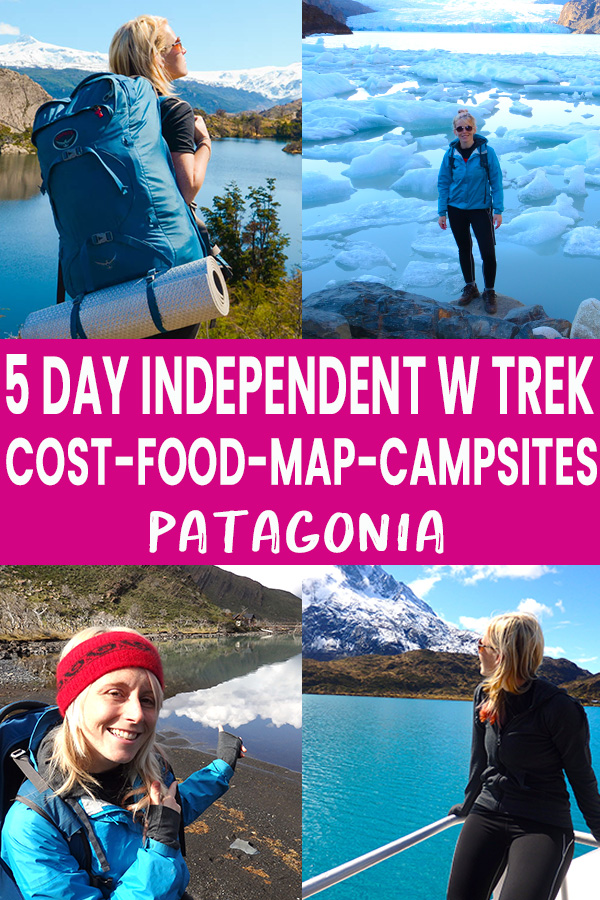
How much does the Patagonia W trek Cost?
There are many tour guided options for the Patagonia W trail and depending on what you want, they can be a great way to see this area of Torres Del Paine; expect to pay anywhere between £1000 and £2000 per person. The main things that effect the guided tour price are group size, season, accommodation, porters and meals. BUT we’re here to help you do trek independently at your own pace over 5 days for as little as £100 per person. Of course, depending on your own choices this will vary too. A full In-context break down of prices is explained in detail further down in this post.
How long is the Patagonia W Trek?
Once you reach the start of the trail, the Patagonia W trek is around 78Km (48 Miles) start to finish. Local buses and a boat are available to take at the very start of the trail and pick you up at the end. You are constantly climbing and descending, so it is important to not under estimate the difficulty of the the trek based on its length. You are however only typically trekking anywhere between 500 meters and 1200 meter. You don’t ever hike above 3000 meters, so no need to worry about altitude sickness.
The W trek torres del paine was one of our top highlights in South America. Torres Del Paine is a stunning national park with a range of routes. You can hike a W trek, a O trek and a Q trek.
Erratic Rock in Puerto Natales does a great talk every day at 3pm. It’s designed to help you get to grips with everything you need for the trek. It is a great way to meet people that will be trekking at a similar time to you. They also let you take free gas that has been left by other hikers!
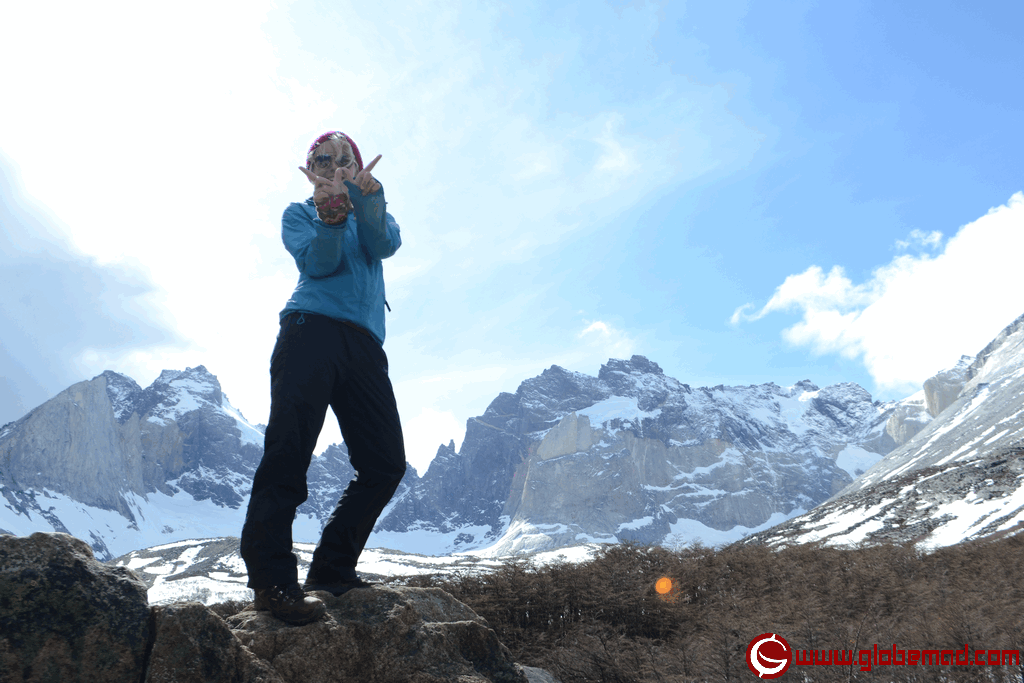
How long does it take to trek the Patagonia W trail?
Depending on your fitness and experience it takes an average of 4 to 7 days to trek the whole Torres Del Paine W Circuit. The most enjoyable, yet still challenging pace for many is the 5 day approach to the trek. This way you can enjoy the challenge but still actually stop and take in the epic mountainous views! If you have longer and want a big trek around Torres Del Paine, the ) circuit O and Q circuit are great options. Each is trek longer than the former and is named based on the letter shape assigned to it. We will focus on the spectacular BIG W trail, completed over 5 days. You can choose to trek west to east or east to west; we will focus on the west to east route. The campsites and refugios vary in price (See Below) and there are several ways to space out where you sleep; we will focus on the cheapest possible way to do it. Do note however the O circuit and Q circuit aren’t available to trek all year round due to seasonal weather dangerous.
How hard is the W trek in Patagonia?
How hard is the trek and how fit do you have to be to trek the Torres Del Paine W trek? If you are taking 5 days it is very manageable for a reasonably fit person who is used to hiking and likes a challenge. It is more about endurance and stamina. Some of the days are longer than others and require a lot of up and down hill hiking. This can be hard on the knees and you may need to consider knee support. Also the terrain can be very rocky, so you may want to consider ankle support. Many hikers use hiking sticks to help with both. Navigation wise, the Patagonia W trek is very accessible, there are marked paths along the whole trail and depending on when you go you are likely to see other on the trail who you could ask if you are feeling lost. In most cases if you follow a path long enough you will reach a refugio or campsite. There is some basic navigation involved and it is not for the inexperienced, but trail is apparent and intuitive on the whole.

When is the best month to trek the Patagonia W Trek?
Summer is more pleasant for hiking, but then more full of tourists for this very reason. Winter is almost empty, but they often shut parts of the trek for weather related safety reasons. Personally we, would recommend spring or autumn. Early spring is our favourite. Very few people on the trail, stunning crisp days, very photogenic as everything is coming back to life. Though it can still get very cold, once you’re wrapped up warm at night, it’s warm enough to sleep outside. Autumn is great if you want to catch fall colours and the later in autumn you go, the less tourists on the trail. SO, it really just depends on what you want.
What should I Bring on the Patagonia W Trek?
The weather can vary beyond belief on the Patagonia W trek, so you have to be well prepared. At the same time, you have to carry everything, so don’t be over prepared. When it comes to what to ware, it is best to work with layers you can build up or take off as needed. We have put together a more comprehensive list on what you may want to pack for the Patagonia W trek as a separate post. This goes into more detail on everything include clothes, toiletries, camping and trekking equipment. For this post we will just focus on camping equipment because this takes more planning and effects cost, as you may need to rent some locally.
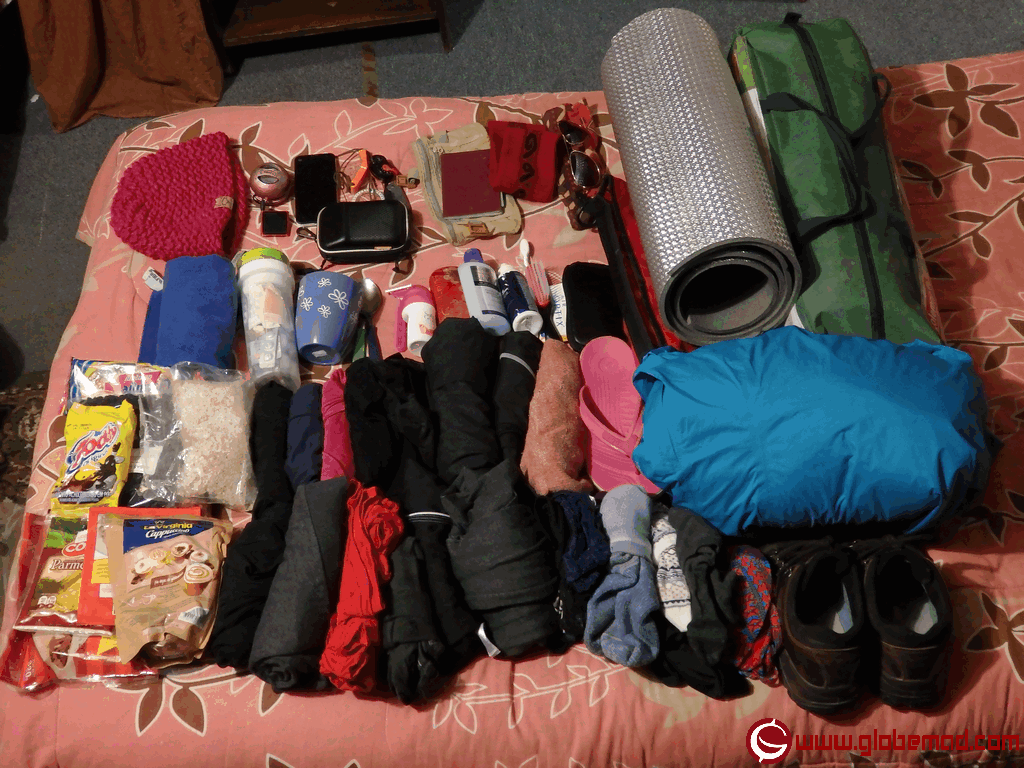
Camping Equipment list for the Patagonia W trek:
Tent | Light weight and low to the ground is ideal due to very strong winds on the w trek torres del paine
Sleeping bag | Try to match it to the season you trek in.
Sleeping mat | Essential to keep the ground from sapping your body heat.
Head torch | Very useful at night time.
Multi Tool | Useful for everything you don’t expect.
Small cooking stove | preferably for gas cans.
Gas cans | Many can get by with one. Check out our awesome cooking and food tips for the trek >>>
Pan with lid and Handle | The pan can double up as your bowl!
Plate | Optional, you may prefer to save washing and eat out the pan.
Fork, spoon, knife
Cup
Lighter & matches | Always have a spare!
Scrubber and some form of soapIf you are missing any of these you can buy or rent them in Puerto Natales where there are both local supermarkets and specialist rental shops. Check out the rental costs from Erratic Rock further down this post.
Trekking Equipment list for the Patagonia W trek
Backpack | 50 – 60 Liters
Daypack | It should fit inside your main pack. This will be great for sections where you can leave your main bag at a camp.
Dry sack | Essential for keeping your valuables dry in a storm.
GPS and Compass | The path is predominantly easy to follow, but it may be a good idea take a GPS or compass uncase you get a little lost.
Walking Poles | surprisingly important, especially if you are carrying a lot weight. Really do recommend these. You can rent them in Puerto Natales.
First Aid | Plasters, anti-histamine, pain killers ect
Drinking bottle| You can fill up water at refugios and many streams
How much food and drink should I take on the Patagonia W Trek?
You can buy food and drink along the trail, there are both shops selling precooked food and small refugio restaurants selling full meal. They are CRAZY expensive! As you would imagine, getting good out to these places cost a fortune, so naturally that is passed on to you. It is nice to know you can buy food and drink along the W trail, but you want to be organised and avoid it at all costs if you are on a budget! It is of course hard to work out what to take so we have done another dedicated post this. How much to take, top tips, meal ideas, drinks, snacks, how much gas you will need and where to buy everything Check out our surprisingly tasty and meal plan for the 5 day Patagonia W trek

How to get to the Patagonia W Trek
Transport for getting to the start of the Patagonia W trek, Torres Del Paine depends on where you’re coming from (of course!) So, just a few little pointers.
There are several Airports in the region. El Calafate in Argentina is the best to use as it is the closest that actually receives flights from a range of places you are likely to be coming from.
There are ways of getting directly to the National Park from El Calafate, but this is more expensive as it has to be part of a bus tour. It costs around 1700 ARS [Learn about Blue Dolar Rate!]
The best way is to Bus to Puerto Natales and use this as your base for setting up. It costs 450 ARS from El Calafate. Then the return is 15.000 CLP (15 GBP / 22 USD) back to El Calafate after your adventure.
All the latest bus and boat timetables are updated on the Torres Del Paine official website.
How to get to Torres Del Paine National Park
Once in Puerto Natales buy an open return bus ticket from Puerto Natales to Torres Del Paine. This costs 13.000 -15.000 CLP (13-15 GBP / 19-22 USD) Maria Jose is the cheapest company.
The latest times are printed on the ticket and designed to work well with your trek.
Transport around Torres Del Panie National Park
Once you are in the park, the bus stops 3 times. It stops as Porteria Laguna Amarga, then Lago Pehoe, then Centro de Visitantes y administration. There is a boat across Lago Pehoe and the rest is up to you. Check out THE Route for more info
Guide to the best way to hike Torres Del Paine W trek
Essential costs of a 5 day Patagonia W Trek
These costs are All based on starting your trip in Puerto Natales and looking to do it the cheapest possible way!
5 days food: Bought in Puerto Natales costs around 20.000 CLP (20 GBP / 25 USD) Top tips on planning your meals >>>
Open return bus ticket from Puerto Natales to Torres Del Paine: 13.000 -15.000 CLP (13-15 GBP / 17-20 USD) Maria Jose is the cheapest company.
Park Entrance Fee: As of 2021 A one day pass is only 21:000 CLP, but you will need the plus pass. The 3 day plus pass has gone upto 35:000 CLP (35 GBP / 42 USD)
Lago Pehoe boat cost: 15.000 CLP (15 GBP / 20USD)
Totally campsites costs: 6.000 CLP (6 GBP / 10 USD) per person if you’re lucky, or 13.000 (13 GBP / 18 USD) Depending on season and availability.
Approximately Total Essential Costs 100.00 CLP ( 100 GBP / 130 USD)
Additional equipment rental costs
This depends on what you already have. Erratic rock has everything you need and is fairly priced. You can shop around, but there is not a lot in it.
Cost shown below are per item, per day |

Costs of camping and refugios on Patagonia W Trek
Campsites Prices
Refugio & Campsite Grey: 6.000 CLP (6 GBP / 10 USD) Per person per night
Refugio & Campsite Paine Grande: 7.000 CLP (7 GBP / 12 USD) Per person per night
Campsite Italiano: FREE
Refugio & Campsite Los Cuernos: 7.000 CLP (7 GBP / 12 USD) Per person per night
Refugio & Campsite Chileno: 8.000 CLP (8 GBP / 14 USD) Per person per night
Campsite Torres: FREE
Refugio Prices
Note, not all campsites have refugios, don’t get caught out!
The refugios vary from 25.000 – 40.000 CLP (25 – 40 GBP / 32 – 52 USD) per person, per night. This is JUST for the bed, so you will still need to take your own sleeping bag. Alternatively, you can pay around an extra 15.000 CLP (15 GBP / 21 USD) for the bedding.
Food at refugios is also very expensive ranging from around 6.000 CLP (6 GBP / 9 USD) for breakfast to 15.000 CLP (15 GBP / 21USD) for lunch and evening meals, drinks are also extra.
It is always best to book in advance. By visiting Erratic Rock’s daily meeting, you can get the latest prices and get help booking your bed
Day By Day guide To Patagonia W Trek
This is a breakdown of what each day of hiking will look like, including locations and timings. Please note, heavy camping bags, full of food, really will slow down your usual average, we are basing timings on the Torres Del Paine National Park averages.
Patagonia W Trek Torres Del Paine map
Also note, they give you a map on arrival at the National Park its self.
Patagonia W Trek Day 1
Most buses leave Puerto Natales around 07:00, you should buy you ticket the day before. The bus takes a couple of hours and drops you inside National Park. There are 3 possible stops. (Porteria Laguna Amarga, then Lago Pehoe, then Centro de Visitantes y administration)
Get off at the second stop, where you can take a have your lunch whilst you wait for the boat across Lago Pehoe to Refugio and Camp Paine Grande. (The boat takes around one hour)
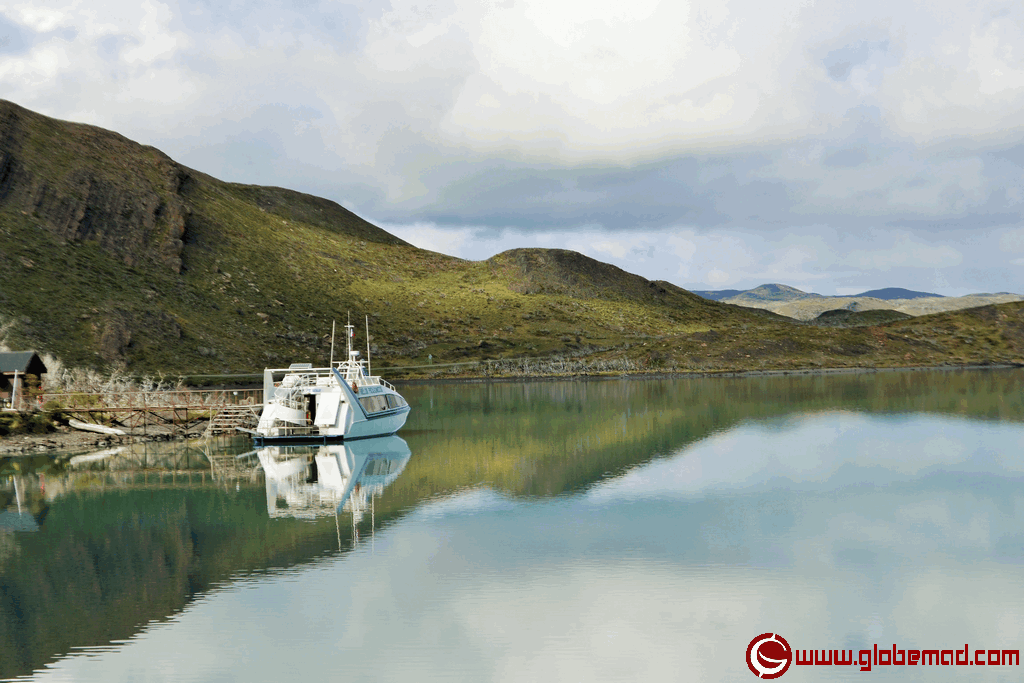
From here the track becomes very apparent. You are heading north west up the track towards Refugio and Camp Grey.

You reach and then pass Laguna Los Patos on the way.
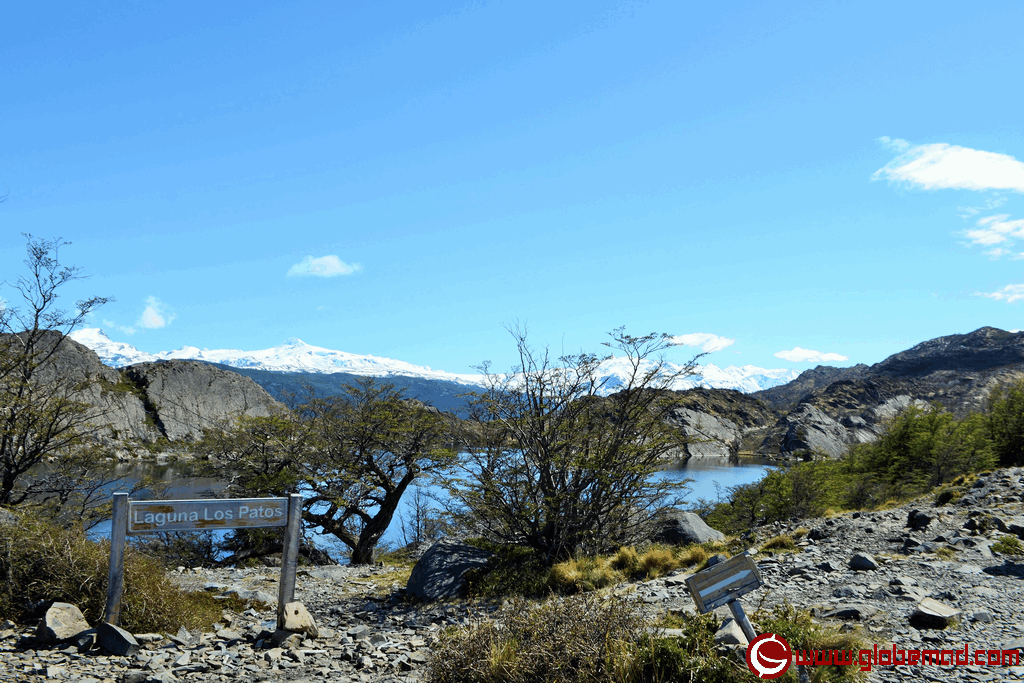
After Laguna Los Patos, you have some beautiful trekking alongside the glacial waters. As you near the Lago Grey sign post, look out for slight detours off the main path so that you can make the most of viewing the epic Glacier Grey.

After arrival, you will want to allow around an hour to walk to and explore the Glacier Mirador (view point) from the campsite. It is only 15 minute walk each way, but it is well worth exploring the area once you’re there. You may even want to brave a swim! Of course this is obscenely dangerous…
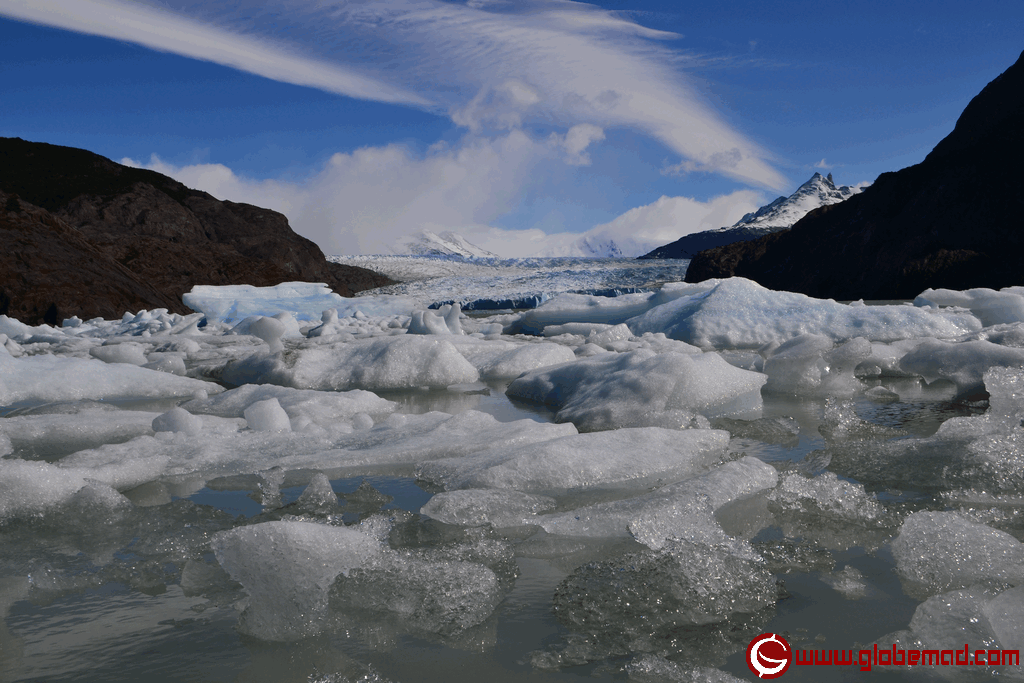
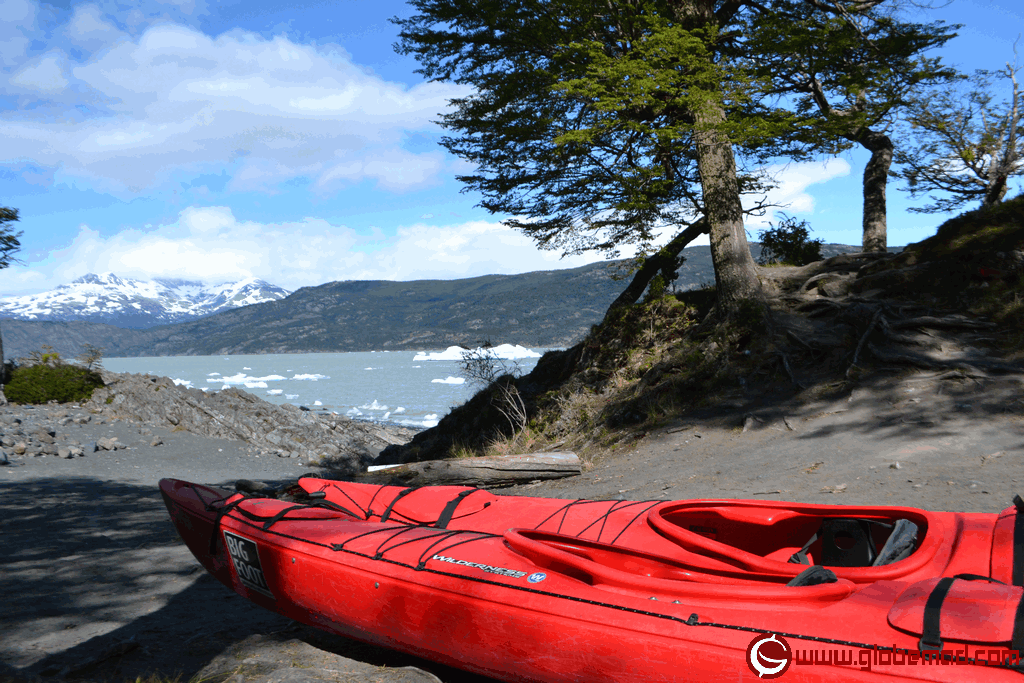
Note you can pay to go canoeing and ice trekking from Grey if you wish. Canoeing is around 80.000 CLP (80 GBP / 140 USD) per person and ice trekking a bit less.
There is a little shop near the campsite and the facilities in general are good.

There is hot water for showers and indoor cooking facilities.
Patagonia W Trek Day 2
A great addition to today’s hiking is to leave your bigger backpack after packing up your tent and walk 1 to 2 hours up the track to view the glacier from above. Naturally as far as you walk up, you will need to walk back.
Once back at Grey, you can pick up your backpack and head back up the track from the previous day. It involves a lot of uphill scrambling and may take longer than the previous day. We estimate around 3.5 to 4 hours.
Before you reach Refugio and Camp Paine Grande there is a sharp turn left where you can begin heading towards Camp Italiano. We estimate 2.5 to 3 hours for this section.

You know you have reached the camp when you see an awesome rope bridge crossing river.

Don’t forget to check into your campsites, it helps them track you if anything goes a bit wrong.
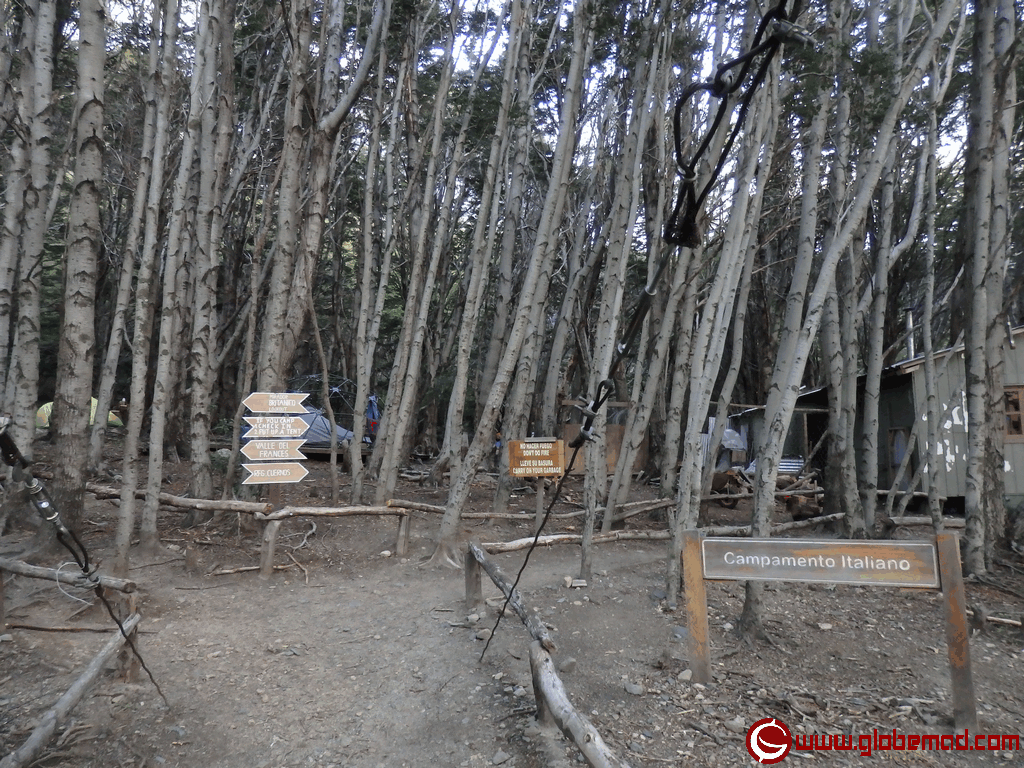
Camping cost at Italiano: Free. It is much more basic, but still has a cooking area, toilets and a stream for drinking water.
Patagonia W Trek Day 3
Hurray! On day 3 you can leave your gargantuan beast of a backpack to trek up and down the Frances valley.
Day three still involves a lot of walking but seems restful by contrast. There is a lot of scrambling involved and winds can pick up. You may see avalanches, but don’t fear, they are from afar. It takes around 2.5 to 3 hours to trek up the valley to the 360 panoramic view point.

Depending on your trekking style you can get back down pretty quickly. If the camp is quiet at Italiano, you may be able to stay an extra night there. Technically, they say you should only stay one night, but they can be flexible if it is quiet. If not, then you have to allow an additional to 2 hours to trek to Refugio & Campsite Los Cuernos.

Camping cost at Italiano: Free. It is much more basic, but still has a cooking area, toilets and a stream for drinking water.
Camping cost Los Cuernos: More expensive bu there is hot water for showers and a decent cooking shelter.
Patagonia W Trek Day 4
Depending on whether you set off from Camp Italiano or Los Cuernos and whether you choose to trek all the way up to Torres view point, you have anywhere between and 20 and 28 km to trek today. You are aiming for Camp Torres. The trail follows the lake for some time before swinging up into the final valley.
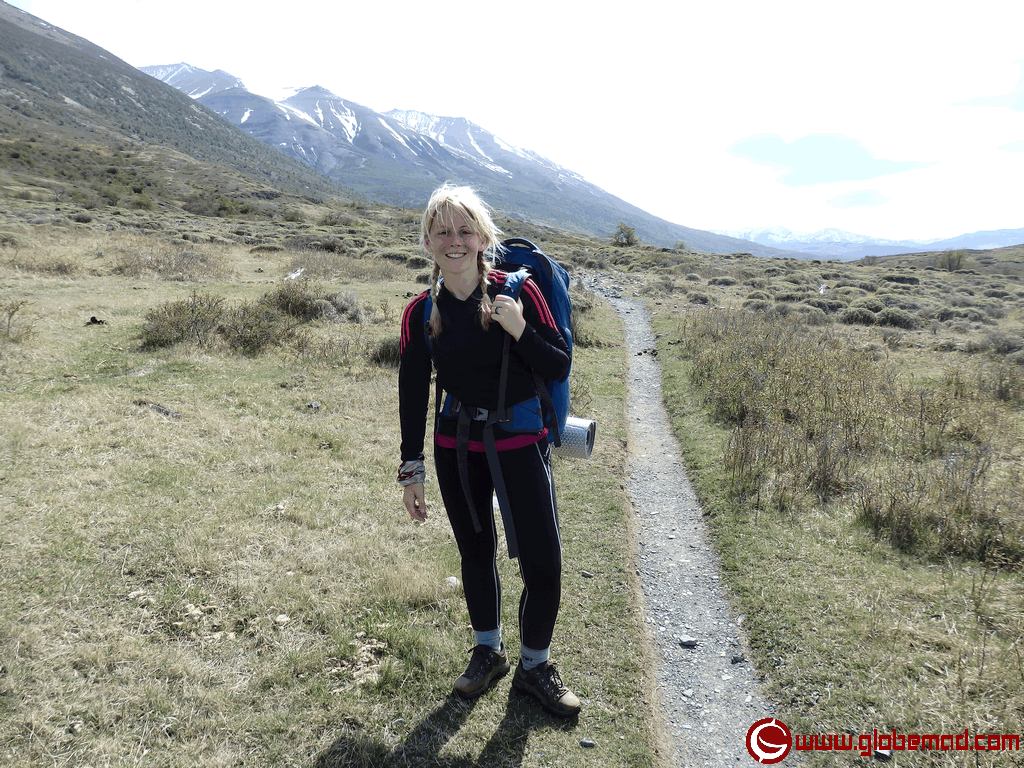
The paths are generally smoother and easy to follow. The track is beautiful and it undulates greatly throughout. As you will be carrying less and the paths are more straight forward, you may find your hiking speed picks back up today. It can take 8 to 11 hours depending on your pace and what you actually decide to do.
It is worth asking about a weather prediction when you check in Camp Torres. This way you can work out whether to go straight up or wait for the next day.
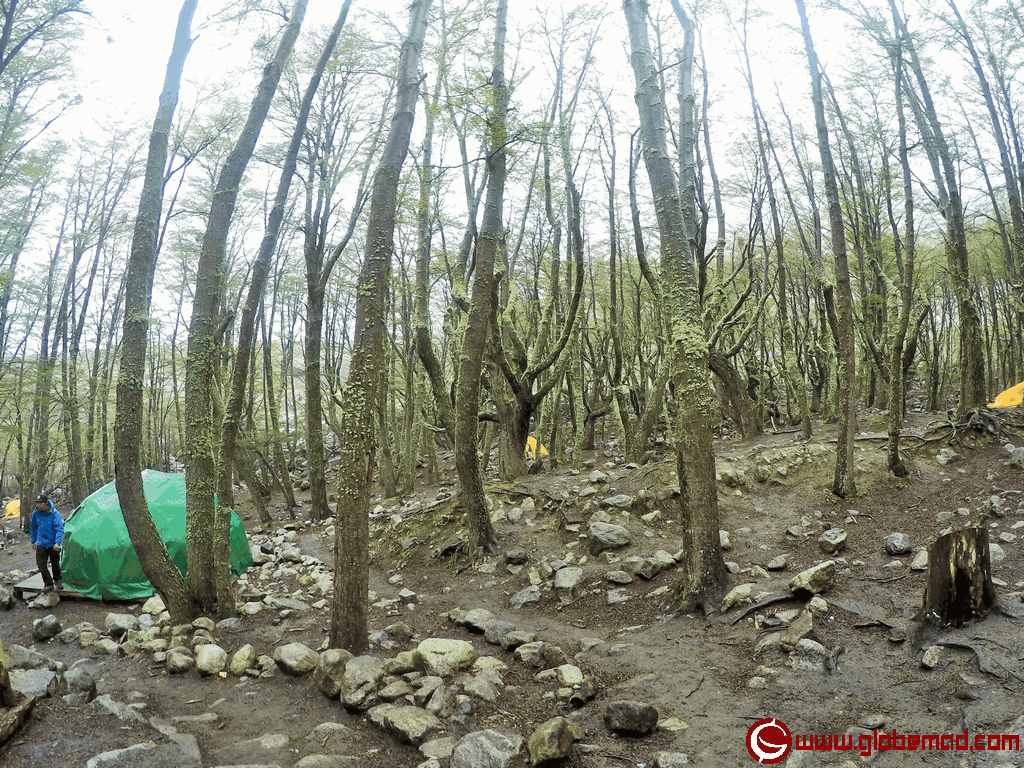
Camping cost at Torres: Free. It is basic, but still has a cooking area, toilets and somewhere to get water drinking water.
Patagonia W Trek Day 5
If you are blessed with a good weather prediction, plan to get up or an epic sunrise. The path upto the view point is really steep and involves much traversing across shale and often fighting high winds, so allow much time and take it carefully. In day light it should take 45 minutes to one hour up, allow more time if you are braving it before sunrise.

You can then make your way back to camp to have breakfast and pack up. From here it can take 3 to 4 hours to hike down to Hotel Los Torres. It is all downhill, so take it easy on your knees.

You can get a bus from Hotel Los Torres to Porteria Laguna Amarga for 2.500 CLP. The buses are set up so they ensure you arrive in time for your bus back out of the park, usually around 14:30.

If you want to save the money, you can hike the road in 1 to 1.5 hours. You are just following the road, so it isn’t that pretty, but if you have the time and would rather spend the money on hot chocolate later, it is worth it!
The buses drop you back off in the main bus terminal in Puerto Natales.

To get to grip with a more personal experience of what it is like day by day on this Patagonia W trek and what photos you can get, check out our photo journey of 5 days trekking in Torres Del Paine





4 Responses
Prady
Thanks for posting your experience. It was helpful. We are planning to go to Torres del Paine NP in March for 3 days and 2 nights. Which hikes would you recommend? We are thinking about hiking the Base of Torres, Grey Glacier (would like to do kayaking), not sure about the third one yet. Is it achievable?
Are there any other private buses we can take later in the day (after 4pm) from the national park to Puerto Natales?
Thanks in advance.
Globemad Emma
Hiya, it will be SO beautiful in March.
The layout of the route makes it harder to do smaller sections of it, there is very little transport within the park, it is geared up to do things in a row really.
I’ll try to make two suggestions, but I would also say if you have 3 days 2 nights you would have to go VERY fast and cut out some parts, if you can spare an extra day it would be worth it.
Option 1:
Day 1: Boat and Trek to the first viewing point of Glacier Gray and then returning to the boat area to sleep. (This means missing Kayaking)
Day 2: Trek as much as you can (Missing the Frances valley/middle of the ‘W’) and try to get Refugio/Camp Chileno or some other accomadtion on the east section of the W. This would be quite an extreme day, but has been done.
Day 3, hiking to Base of Torres then head back down and out the park.
Option 2:
Could include Kayaking, but is a bit more risky due to lack of internal transport.
Day 1: Boat and Trek as fast asyou can to Glacier Gray, go Kayaking and sleep there.
Day 2: If you get up really early you should be able to get back to the boat on time. Take the boat back then make your way to accommodation near the east side of the ‘W’ / near the base of Torres.
You will need to double check boat and bus timings on your first day.
BUSES: Most of the buses leave the park at 14:30 to head back to Puerto Natales. Some people that had booked package deals had buses leaving latter in the day, but they were quite expensive and might have other restrictions on them.
To be honest 3 days 2 nights might just be a bit too short for what you’re hoping to do. I know it’s frustrating, we spent ages trying to weigh it all up.
Really hope this helps, have an epic time!
Ana Rios
Hi I just found this and was thinking to do this at the end of April do you think it’s too late to book this? Also I’m a female who will be going alone, do you feel this will be an issue? I’m not sure about the wildlife here
Globemad Emma
Hiya Ana, end of April is the very end of the recommended season, but can certainly still be a great time to travel. If you head to Puerto Natales you will be able to check with locals If it is still safe. If you are well prepared it should be fine. The tracks are very well trodden and there are often others on the trail, most of the year round. If any paths are deemed unsafe they typically close them. Wildlife shouldn’t be a big problem, its rare people encounter anything on the trails, but I guess there is risk in everything. http://www.erraticrock.com are a GREAT hostel and trekking company based in Puerto Natales, great for hiring equipment and meeting people to trek with. They also do a free hiking briefing every day!